
Share
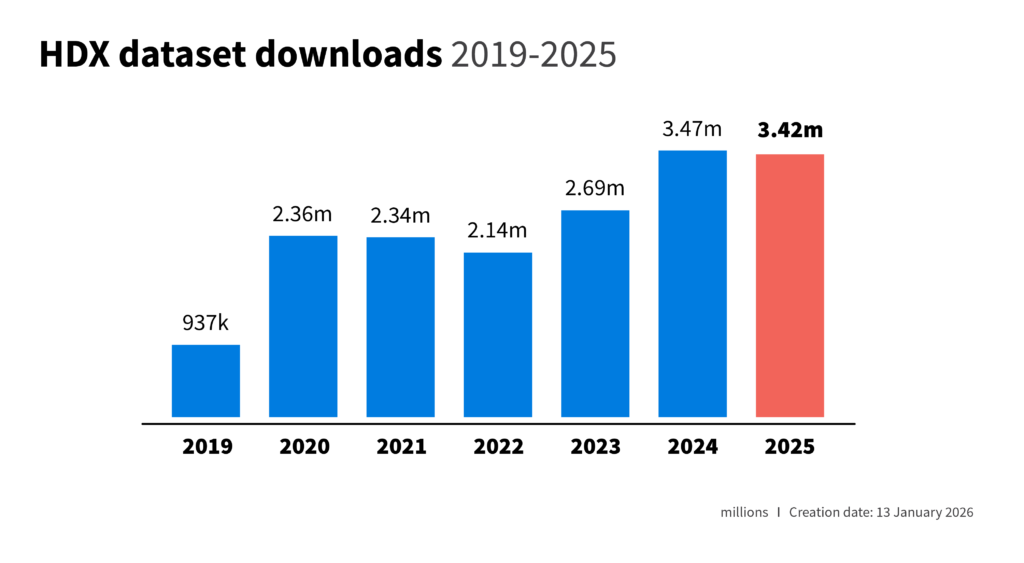
In 2025, the Humanitarian Data Exchange (HDX) platform continued to play an important role in bringing together data across organizations and crises. While significant funding cuts across the sector impacted the volume and frequency of data collection in humanitarian operations, the demand for data from HDX users remained high. By the end of the year, over 200 partners were sharing 20,000 datasets, which had been downloaded over 3.4 million times.
 In 2025, the number of unique users on HDX more than quadrupled to 5.8 million, up from 1.4 million in 2024. This dramatic increase is driven by automated traffic, which originates from AI-related agents or bots, a challenge all websites are dealing with due to growth in Large Language Models such as ChatGPT. Despite this issue and the inflated numbers it produces, we remain confident that HDX continues to gain traction with our core audience: real life humanitarians. We see this growth when we look at user activity that is not affected by automation. For example, the number of users manually downloading data grew by nearly 10 percent in 2025.
We welcomed 26 new organizations to HDX throughout the year. A few highlights include:
- Climate Hazard Center at UC Santa Barbara produces CHIRPS (Climate Hazards Group InfraRed Precipitation with Station data) and provides high-resolution climate projections used to monitor emerging hazards and support crisis response and food security analysis.
- Green Climate Fund shares global climate finance data, helping analysts track investments that support resilience and adaptation efforts in vulnerable countries.
- The Philippine Space Agency is the government agency for space science and technology activities. Their datasets show the actual extent of flooding in the Philippines caused by typhoons or tropical cyclones on a monthly basis, as observed through available satellite imagery.
- PortWatch contributes global trade and seaports disruption data, offering insights used to anticipate supply chain impacts during crises. PortWatch is a joint initiative of the International Monetary Fund, the University of Oxford, and Delft University of Technology.
- Violence & Impacts Early-Warning System (VIEWS) shares monthly forecasts for violent conflicts across the world up to three years in advance.
Existing and new organizations shared 3,218 new datasets, while another 17,200 datasets were updated. Nearly 87 percent of all datasets on HDX are shared programmatically via APIs, which ensures faster and more consistent updates. Throughout the year, we archived 2,449 datasets that were more than five years old. The HDX archive now includes over 6,600 datasets, which remain available to explore and download.
In a year filled with uncertainty and change, the humanitarian data ecosystem continued to prioritize sharing data openly, ensuring our global community has access to data that can save and transform lives. A powerful example of this came from Sauti East Africa, an NGO based in Kenya which uses HDX to access trusted datasets, including market prices, exchange rates, food security and climate data. Sauti, which means ‘voice’ in Swahili, translates this data into short, simple text messages that are used by women traders to make decisions about where to buy and sell their goods to avoid exploitation, plan routes that reduce food spoilage and locate nearby health services.
We are grateful to all of our partners for their collaboration and commitment to making humanitarian data easy to find and use. We will provide more insights about the data on HDX, the impact of funding cuts, and what to do about AI bots in The State of Open Humanitarian Data 2026 report, which will be released in March.